


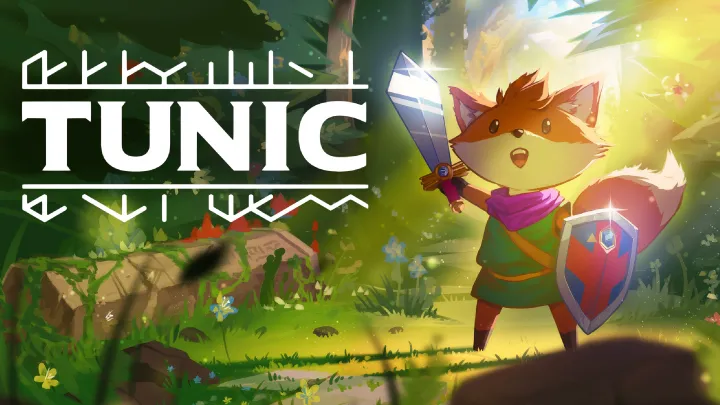
Released in 2022 after seven years of development by designer Andrew Shouldice (Isometricorp Games), TUNIC is far more than its charming, isometric façade suggests. This action-adventure game about a small fox in a grand, ruined world is a masterful exercise in meta-design, drawing inspiration from the open-ended exploration of classic The Legend of Zelda titles and the challenging, unforgiving combat of Dark Souls. However, its true genius lies in its central mechanism: the deconstructed in-game Instruction Manual. By scattering pages of this beautifully illustrated, mostly untranslatable artifact across the hostile landscape, TUNIC forces the player to engage with the kind of primal discovery and shared community knowledge that defined early console gaming. In late 2025, the game continues to be celebrated not just for its difficulty and cute aesthetic, but for its profound, cyclical narrative and the depth of its hidden secrets.
 1. The Design Philosophy: Nostalgia as a Puzzle
TUNIC's development was guided by a single, powerful sentiment: the feeling of exploring a game you don't fully understand, reminiscent of poring over a foreign or cryptic game manual as a child.
The Power of Unknowing
Andrew Shouldice deliberately engineered the experience to foster "genuine discovery and mystery." The player is initially given zero instruction. Most in-game text, including signs and map labels, is written in an invented constructed language (known as Trunic) that the player is not expected to decipher to beat the first half of the game. Instead, the beautifully drawn illustrations, diagrams, and annotated maps within the scattered Instruction Manual pages provide the only hints, forcing players to rely on visual context, experimentation, and intuition to understand basic mechanics like blocking, parrying, and item usage.
The Blur Between Player and Protagonist
The manual pages also serve a deeper narrative function. The player's journey of piecing together the manual—a journey of knowledge—mirrors the fox protagonist's journey of breaking a cursed cyclical time loop. The true ending, which is only accessible after collecting and decoding the complete manual, links the player's external puzzle-solving with the fox's internal quest, blurring the line between the gamer and the in-game hero.
2. The Core Mechanics: Zelda Meets Souls
While the visuals evoke a top-down Zelda, the moment the small fox draws its sword, the influences shift to a challenging, modern action-RPG paradigm.
Technical, Stamina-Based Combat
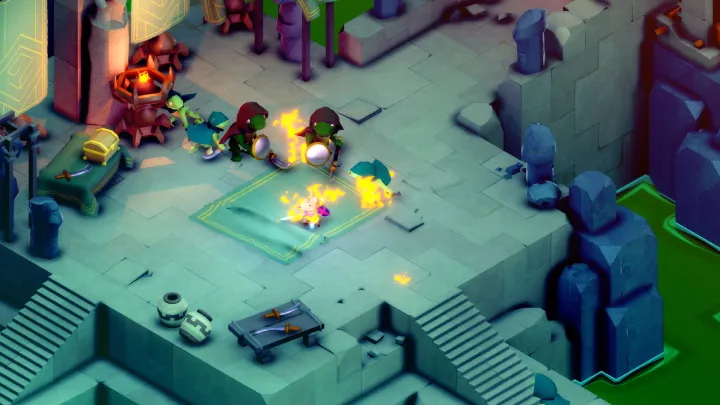
Combat is a technical dance. The fox utilizes a stamina meter for dashing, blocking, and attacking, a clear nod to "Souls-like" design. Successful players must master dodging, blocking incoming fire, and the high-risk, high-reward ability to parry enemy attacks for a massive stun window. The isometric camera and hidden perspectives often obscure enemy positioning, adding a layer of deliberate spatial challenge.
Progression Through Found Knowledge
Progression is non-linear and knowledge-based. Crucial abilities, like the lock-on feature (L-Trigger/LT), are not tutorials but are revealed only on a page of the Instruction Manual found deep in the world. Learning these "secret" mechanics through the manual—and then applying them to the game world—is the primary method of power progression, often leading to huge "aha!" moments that re-contextualize previously insurmountable areas.
3. The Instruction Manual: A Meta Masterpiece
The 55-page Instruction Manual is the heart of the game and a genuine artifact of game design, lauded for its intricate layers of information and misdirection.
The Art and Annotations
Each page features full-color, hand-drawn art, mirroring the quality of classic Nintendo manuals. They contain maps, enemy bestiaries, item descriptions, and controls. Critically, some pages feature handwritten annotations in English—sometimes a helpful tip, sometimes a personal note from a previous player or entity—which adds layers of story and hints that reward obsessive scrutiny.
The Holy Cross Puzzle
The final layer of the manual's secrets revolves around the Holy Cross, a powerful relic and a sequence of directional inputs (Up, Down, Left, Right) that can be activated on the controller. The full Golden Path solution—a massive, multi-step, meta-puzzle required for the true ending—is literally hidden within the finalized pages of the manual, requiring players to treat the manual itself as a decoder ring to be solved outside of the game's core framework.
4. The Lore: The Cycle of the Heir
The game's narrative is a tragic tale of ruin, powerful magic, and a recurring, self-destructive cycle.
The Downfall of the Ancient Foxes
The world was once a thriving civilization of foxes who sought forbidden knowledge and immortality by harnessing the power of the Holy Cross and the obelisks. Their quest for power led to a catastrophic event, an apocalyptic collapse of reality caused by a corrosive Purple Miasma. The civilization perished, leaving behind only ruins and lingering spirits.
The Heir and the Time Loop
The antagonist, The Heir, is a tragic figure: a past hero who succeeded in their quest but became trapped in a crystal prison, locked into a perpetual time loop as a beacon for the next hero to replace them. The little fox protagonist is drawn into this cycle. The player's journey involves collecting the three Keys to free the Heir, only to be immediately defeated and become the Heir—the "bad ending"—perpetuating the cycle. The true ending only occurs when the fox, using the knowledge gained from the full manual, refuses the cycle and frees the Heir by non-violent means.
 5. Critical and Commercial Success
TUNIC has achieved sustained success since its 2022 launch, finding a dedicated audience across all major platforms.
Reception and Sales Figures
The game was universally praised by critics, achieving a Very Positive rating on Steam (over 91% positive user reviews) and a high critical Metacritic score. While official total sales are not public, estimates place its units sold on Steam alone near 500,000 units, with an estimated gross revenue of over $11 million on that platform. This indicates a strong commercial performance for an indie title.
Full Platform Availability
Originally released on PC and Xbox, the game quickly expanded, later arriving on PlayStation 4/5 and the Nintendo Switch, ensuring the challenging experience is available to the widest possible audience. The game performs well on devices like the Steam Deck, further cementing its appeal as a portable title.
6. The Developer Team and Production History
TUNIC is primarily the vision of one man, Andrew Shouldice, and the dedication to this vision spans nearly a decade.
Seven Years of Solitary Design
Shouldice started the project in 2015 under the working title Secret Legend. He wanted to prove that a small, modern game could still provide the feeling of profound discovery and complexity associated with early gaming. As the project grew, he brought in key collaborators, including producer Felix Kramer, and the team at Finji (publishers of Night in the Woods) for publishing and direction.
The Audio Atmosphere
A critical component of the game's atmosphere is its music, composed by LIFEFORMED (Janice Kwan) and Power Up Audio. The score perfectly balances the cute, whimsical side of the fox with the melancholy, vast sense of dread that pervades the ruined kingdom, reinforcing the emotional duality of the game.
7. The Speedrunning Landscape
The game's complexity and numerous sequence breaks have created a competitive speedrunning scene, with runners exploiting knowledge-based shortcuts.
Sequence Breaks and Exploits
The speedrunning community leverages the game's design to execute "sequence breaks," often using the isometric camera perspective to walk through unintended geometry or utilize advanced movement techniques. Runs are categorized by whether they require "Major Glitches" (M.G.) or are "No Major Glitches" (N.M.G.). The current N.M.G. speedrun world record is close to one hour, a run which involves near-perfect routing and technical execution, showcasing a mastery of the game's map design.
8. The Ongoing Community and Secrets
Years after launch, the TUNIC community remains highly active, continually dissecting the lore and providing assistance to new players.
Trunic Translation and Shared Knowledge
While not required to beat the game, the community has successfully translated the Trunic writing system, often through crowdsourced efforts, allowing players to fully decode the in-game manual and various environmental texts. The game's vibrant Discord channel acts as the modern-day equivalent of the playground, where secrets and solutions are shared, fitting the game's theme of knowledge transmission.
The "Content For No One" Detail
Shouldice famously stated he included "content for no one"—secrets so deep that very few players would ever find them. This philosophy drives the community's relentless search for every last hidden treasure and coded message, ensuring the game’s mysteries continue to unfold years after release.
9. Real-World Cultural Impact
TUNIC's success has transcended the digital realm, impacting real-world culture through live events.
TUNIC: Live in Concert
The game's soundtrack has been celebrated with live concert performances. An official event, TUNIC: Live in Concert, was held in London in December 2025, featuring a six-piece musical ensemble performing new arrangements of the game's score. This underlines the game's artistic and emotional resonance with its global fanbase.
 10. The Ultimate Ending: Wisdom and Strength
The philosophical message of TUNIC is revealed in its final choice: a meditation on the cyclical nature of power and knowledge.
Breaking the Cycle
The good ending is not achieved through raw strength or power, but through Wisdom (the full manual) and Strength (the ability to act). By collecting all the knowledge of the past and refusing to violently challenge the Heir, the fox breaks the destructive cycle of the ancient foxes, proving that genuine progress requires understanding the mistakes of the past rather than simply repeating them in the pursuit of power.
Conclusion: A Timeless Work of Interactive Archeology
TUNIC is a modern masterpiece of action-adventure design, uniquely leveraging nostalgia for classic game manuals to create a fresh, profoundly challenging, and knowledge-driven puzzle box. Years after its release, its core loop—the satisfaction of decoding a language, interpreting a hand-drawn map, and applying that esoteric knowledge to a dangerous world—remains unparalleled. As the community continues to find the "content for no one" and the game's concerts fill venues, TUNIC has cemented its legacy as a timeless work of interactive archeology that rewards patience, curiosity, and a willingness to feel delightfully, frustratingly lost.