






Introduction
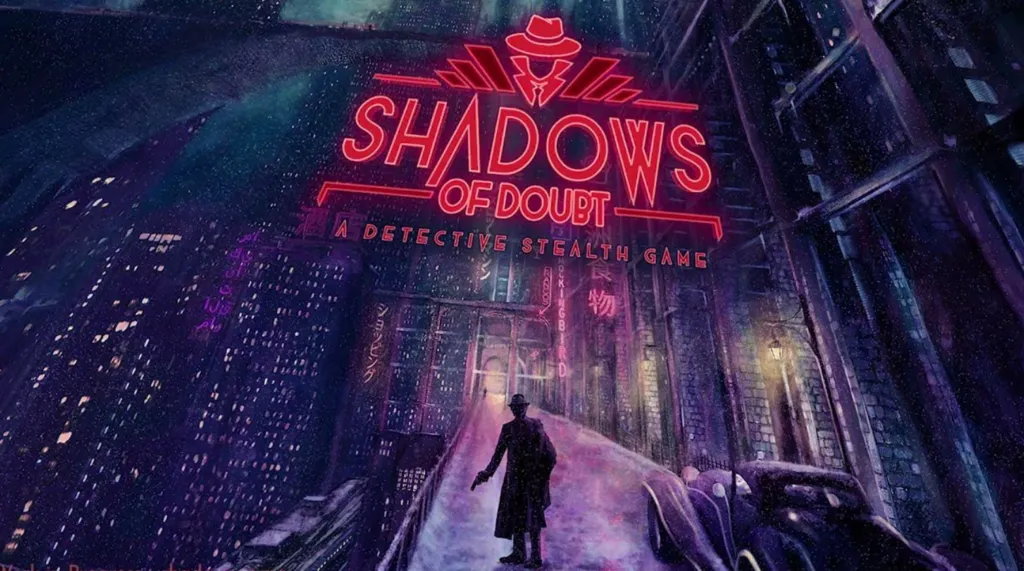
Shadows of Doubt entered the indie scene with an ambitious promise: a fully simulated city where every citizen has a life, every crime is procedurally generated, and every case can be solved using logic rather than scripted clues. At launch, the game was praised as a revolutionary detective sandbox. However, as player hours increased and updates rolled out, a specific issue emerged at the center of community discussion and developer response: the long-term breakdown of procedural detective coherence.
This article focuses on a single, deep issue rather than a general review. It examines how Shadows of Doubt’s procedural crime system begins to collapse under extended play, why this matters for the future of simulation-driven detective games, and what recent updates reveal about the limits of procedural storytelling.
1. The Original Promise of Infinite Crimes
At its core, Shadows of Doubt marketed itself as an answer to scripted detective fatigue. Instead of pre-written cases, the game offered endlessly generated murders, thefts, and conspiracies, all embedded within a living city simulation.
Early impressions supported this promise. First-time players experienced genuinely tense investigations, where missing a fingerprint or misreading a note could derail an entire case. The absence of hand-holding created a sense of authenticity rarely seen in detective games.
However, this strength also laid the foundation for future problems. Because the system relied entirely on procedural logic rather than narrative safeguards, the game’s long-term consistency depended on systems that were never designed to scale infinitely without degradation.
2. When Procedural Logic Starts Repeating Itself
Pattern Recognition Becomes the Enemy
After several dozen cases, experienced players began noticing repetition. Murder methods, motive structures, and clue placements started to feel familiar, even predictable.
Procedural systems excel at variation, but not at meaning. Over time, players learned how the algorithm “thinks,” turning investigations into pattern recognition exercises rather than genuine detective work.
Community Discovery and Meta-Gaming
Online discussions accelerated this issue. Players shared optimal investigation routes, common killer behaviors, and efficient clue hierarchies. What once felt organic slowly transformed into a solvable formula.
This was not a failure of players but a structural weakness in the system itself.

3. The Illusion of a Living City
Simulation vs Narrative Depth
Shadows of Doubt simulates daily routines, jobs, relationships, and schedules for thousands of NPCs. On paper, this creates a believable city.
In practice, the simulation lacks narrative memory. NPCs do not meaningfully react to previous crimes, arrests, or personal trauma. A murderer caught today may be replaced tomorrow by another procedurally identical offender.
This absence of narrative persistence undermines emotional investment and reduces crimes to mechanical events rather than meaningful disruptions.
Why This Matters for Detective Games
Detective fiction thrives on consequence. Without lasting impact, investigations feel hollow, regardless of complexity.
4. Evidence Systems That Break Under Pressure
Fingerprints Everywhere
Fingerprints are central to Shadows of Doubt, but over time they become less reliable. Shared spaces generate massive fingerprint overlap, often implicating dozens of innocent NPCs.
Instead of narrowing suspects, evidence can sometimes expand uncertainty to an unmanageable degree, forcing players to brute-force investigations.
Surveillance Overload
Cameras and databases provide powerful tools, but they also encourage non-deductive play. Players increasingly rely on database cross-referencing rather than physical investigation.
This shifts the game away from detective fantasy and toward administrative efficiency.
5. The Mid-Game Wall Players Hit
Case Fatigue Sets In
Many players report a distinct “wall” around 15–25 hours. Cases stop feeling fresh, rewards plateau, and the city loses its sense of mystery.
At this point, the procedural system no longer surprises. The player knows what to expect before the crime is even solved.
Developer Acknowledgment
Recent developer notes have subtly acknowledged this issue, emphasizing improvements to motive diversity and behavioral logic rather than surface-level content additions.

6. Procedural Motives Without Emotional Context
Motives Exist, But Feel Abstract
Crimes technically have motives: jealousy, debt, obsession. However, these motives rarely manifest in visible world changes.
A love triangle might exist in data, but NPC dialogue, behavior, and environment rarely reflect emotional tension.
Why Emotional Signals Matter
Detective work depends on reading people, not databases. Without emotional cues, motives feel like numbers rather than stories.
7. Updates That Reveal Structural Limits
Content vs Systemic Repair
Several updates added new items, locations, and crime types. While welcome, they did little to address the systemic repetition at the heart of the issue.
This reveals a difficult truth: procedural storytelling problems cannot be solved with content alone.
The Cost of Infinite Design
True infinite systems require exponential complexity, which is often impractical for indie teams.
8. Community Mods as Unofficial Fixes
Modders Attempt to Add Depth
Mods have attempted to introduce new crime logic, expanded motives, and behavioral randomness. Some succeed temporarily.
However, mods cannot fundamentally rewrite the simulation core without access to engine-level systems.
What This Says About Player Demand
The popularity of these mods signals a desire not for more crimes, but for more meaningful ones.
9. Lessons for Future Procedural Games
Shadows of Doubt serves as a case study for future developers:
- Procedural variety is not the same as narrative depth
- Infinite content requires finite emotional anchors
- Detective systems must resist optimization by design
These lessons extend beyond detective games into roguelikes, survival sims, and emergent narrative titles.
10. The Future of Shadows of Doubt
Can the Issue Be Fixed?
Partial solutions exist:
- Dynamic NPC emotional states
- City-wide consequence systems
- Long-term criminal arcs
Whether these are feasible remains uncertain.
What the Game Still Achieves
Despite its flaws, Shadows of Doubt remains one of the most ambitious detective simulations ever created. Its failures are as instructive as its successes.
Conclusion
Shadows of Doubt does not fail because it lacks ambition. It struggles because it pushes procedural systems into territory traditionally owned by authored storytelling. The breakdown of long-term detective coherence highlights the limits of procedural design when emotional consequence is absent.
Rather than diminishing the game’s importance, this issue positions Shadows of Doubt as a critical experiment—one that future developers would be wise to study closely.
160-character summary
Shadows of Doubt reveals how procedural detective systems break down over time, exposing the limits of infinite crime generation without emotional consequence.