How to build the fastest progression route in Windrose without wasting your first 30 hours

Most new Windrose players make the same mistake during their first week: they play the game like a traditional survival sandbox. They gather random resources, build oversized bases too early, craft low-tier weapons they will replace in two hours, and sail into dangerous ocean zones without understanding how progression scaling actually works.
Windrose looks relaxed on the surface. The oceans are beautiful, islands appear inviting, and the early game gives players a false sense of freedom. But underneath that freedom is a progression system that quietly punishes inefficiency. Poor early decisions can slow your advancement dramatically, especially once ship upgrades, crew management, faction hostility, and resource routing begin stacking together.
The difference between experienced players and beginners is not combat skill alone. Veteran players understand how to compress progression. They know which islands to ignore, which blueprints matter, how to avoid “resource traps,” and when to transition from survival mode into economic dominance.
This guide is not a beginner overview. It is a deep progression-focused strategy breakdown designed specifically for players who want to accelerate their Windrose journey efficiently without wasting dozens of hours.
Instead of explaining basic controls or generic crafting advice, this article focuses on one specific goal:
How to create the fastest and safest progression path from early-game survivor to mid-game naval powerhouse.
The guide is arranged chronologically based on how efficient players actually progress through Windrose.
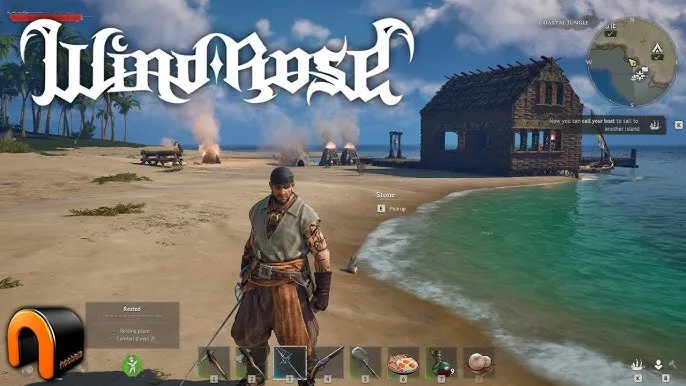
Why your first island decision secretly determines your entire progression speed
Most players think the starting island only affects the first one or two hours. In reality, your spawn region influences resource access, travel efficiency, faction exposure, and ship progression far longer than expected.
The biggest mistake beginners make is building permanent infrastructure immediately after spawning. Windrose’s map design intentionally tricks players into overcommitting early. The first island usually lacks several critical mid-tier materials needed for advanced ship upgrades.
Efficient players instead treat the starting island as temporary.
Your first objective is not base building.
Your first objective is information gathering.
During the first 60–90 minutes, prioritize:
- Mapping nearby islands
- Locating iron deposits
- Identifying freshwater density
- Discovering hostile faction patrol routes
- Checking coastline depth for future docking
- Finding abandoned shipwreck spawn points
Many top players intentionally avoid constructing large storage systems early because relocation becomes inevitable later.
A small mobile infrastructure setup works far better.
How to avoid the early-game resource trap that ruins progression
Windrose contains several “false priority” resources that appear important but actually waste enormous time.
New players commonly overfarm:
- Decorative wood variants
- Excessive fiber bundles
- Low-tier stone
- Common animal hides
- Basic rope materials
The problem is not that these materials are useless. The problem is opportunity cost.
While beginners spend hours optimizing primitive storage and cosmetic upgrades, experienced players rush materials tied directly to progression bottlenecks.
The most important early-game materials are:
- Iron ore
- Resin
- Salt-treated timber
- Sailcloth fibers
- Copper fragments
- Navigation components
These resources unlock the systems that scale progression exponentially:
- Faster ships
- Better cargo capacity
- Efficient travel
- Improved durability
- Expanded crafting access
The strongest early strategy is minimizing unnecessary crafting.
How experienced players build “temporary bases” instead of permanent homes
One of Windrose’s smartest hidden mechanics is travel inefficiency.
Large permanent bases become liabilities surprisingly fast because the game gradually pushes players toward wider exploration routes. If your infrastructure becomes too centralized too early, resource transportation starts consuming huge amounts of time.
Advanced players therefore build in phases.
The ideal early-game base structure
Phase 1:
- Small dock
- Campfire
- Minimal storage
- Repair bench
- Bedroll
Phase 2:
- Portable crafting setup
- Compact warehouse
- Food preservation station
- Ammo crafting station
Phase 3:
- Centralized naval hub
- Defensive fortifications
- Trade routing system
- Crew housing
The key difference is timing.
Beginners jump directly to Phase 3 before unlocking the systems that justify it.
This slows progression dramatically.
Why your first ship upgrade matters more than your first weapon
Most survival game players instinctively prioritize combat upgrades first.
Windrose rewards transportation upgrades instead.
The reason is simple: travel speed affects everything.
A stronger sword only improves combat encounters.
A faster ship improves:
- Resource farming
- Exploration
- Quest completion
- Escape potential
- Trade efficiency
- Blueprint collection
- PvP survival
The first major power spike in Windrose comes from mobility, not damage output.
Efficient players prioritize:
- Sail efficiency
- Cargo expansion
- Hull reinforcement
- Steering responsiveness
- Navigation tools
Only after those systems stabilize should players heavily invest in combat specialization.
This single mindset shift can reduce progression time by dozens of hours.
How to use ocean routes correctly instead of sailing randomly
One of the least understood mechanics in Windrose is ocean routing efficiency.
Most players sail in straight lines.
Experienced players do not.
Windrose secretly rewards players who understand:
- Wind direction systems
- Current acceleration
- Storm positioning
- Safe travel corridors
- Pirate patrol cycles
Improper navigation wastes enormous time and resources.
For example, sailing directly against major wind corridors increases:
- Durability decay
- Food consumption
- Repair frequency
- Fuel usage
- Exposure to hostile events
Veteran players instead establish repeatable shipping loops.
A strong mid-game loop usually includes
- One iron-heavy island
- One trade-oriented port
- One food production zone
- One salvage route
- One neutral repair location
This creates sustainable progression instead of chaotic exploration.
How to farm rare blueprints without relying on luck
Blueprint progression becomes one of the biggest walls in Windrose around the mid-game.
Many players assume rare schematics are random.
That is only partially true.
Windrose actually uses layered loot weighting based on:
- Region danger level
- Time spent in contested zones
- Ship tier
- Faction reputation
- Dungeon completion order
Players who repeatedly farm low-level zones usually remain stuck with weak progression because advanced blueprint tables do not activate consistently there.
Efficient farming requires targeted risk.
The best blueprint farming strategy
Focus on:
- Medium-danger ruins
- Rotating naval events
- Sunken convoy sites
- Faction raid encounters
- Weather-triggered shipwrecks
Avoid:
- Beginner caves
- Standard camps
- Safe-zone contracts
- Low-level treasure maps
Another major mistake is hoarding unopened maps.
Windrose dynamically scales some treasure rewards based on progression stage. Delaying certain maps can actually improve loot quality.
Why faction reputation is more important than most players realize
At first glance, Windrose factions appear optional.
They are not.
Faction systems quietly control:
- Trade discounts
- Rare material access
- Docking rights
- Patrol assistance
- Blueprint availability
- Smuggling opportunities
New players often damage faction standing accidentally through random attacks or careless theft.
This becomes extremely costly later.
Experienced players intentionally manipulate faction reputation instead of treating it emotionally.
For example:
- Temporary alliance farming
- Controlled hostility cycling
- Reputation reset timing
- Black market access optimization
One advanced strategy involves maintaining moderate hostility rather than maximum friendship because certain smuggler systems only appear when reputation falls within specific thresholds.
The game rarely explains these systems directly.
How to transition from survival gameplay into economic dominance
The true turning point in Windrose occurs when players stop surviving and start controlling economies.
Most beginners remain trapped in resource gathering loops forever.
Veteran players transition into production chains.
Instead of farming individual resources manually, they create systems that multiply efficiency.
Examples of scalable systems
- Automated fishing routes
- Crew-based lumber gathering
- Trade arbitrage loops
- Salt preservation production
- Ammunition manufacturing
- Salvage route rotations
This is where ship specialization becomes critical.
Efficient fleets often include:
- One cargo vessel
- One fast scout ship
- One combat escort
- One salvage-focused vessel
Players who continue using one “do everything” ship usually experience severe inefficiency later.
How advanced players prepare for PvP before entering PvP zones
One of the biggest beginner mistakes is treating PvP like standard combat.
Naval PvP in Windrose is mostly preparation, positioning, and logistics.
The actual battle often ends before cannons even fire.
Experienced PvP players prepare through:
- Wind positioning
- Ammunition variety
- Escape route mapping
- Repair stockpiling
- Crew assignment optimization
- Cargo weight balancing
A slower overloaded ship becomes an easy target regardless of weapon quality.
Another major factor is visibility management.
Storms, fog, and nighttime conditions dramatically affect engagement ranges. Skilled players intentionally travel during low-visibility windows to reduce ambush risk.
The strongest PvP captains are usually not the most aggressive players.
They are the most prepared players.
How to avoid the late-game burnout that affects most Windrose players
Windrose’s late-game progression can become repetitive if players fail to shift goals correctly.
Many players burn out because they continue grinding resources long after they should transition toward strategic gameplay.
The healthiest late-game structure includes:
- Territory control goals
- Naval dominance objectives
- Economic specialization
- Rare fleet collection
- PvP campaigns
- Event participation
- Community trade systems
Another critical mistake is solo overextension.
Windrose increasingly rewards coordinated specialization.
Groups that divide responsibilities progress dramatically faster than players attempting to master everything alone.
For example:
- One player handles ship engineering
- One focuses on trade
- One specializes in combat
- One manages exploration routes
This creates exponential efficiency scaling.
Why understanding progression psychology matters more than raw skill
One of Windrose’s most misunderstood aspects is pacing psychology.
The game constantly tempts players into distraction.
You will always see:
- Another island
- Another blueprint
- Another cosmetic upgrade
- Another side activity
- Another resource opportunity
The players who progress fastest are not necessarily the most talented.
They are the most disciplined.
Efficient progression requires:
- Ignoring unnecessary crafting
- Delaying vanity upgrades
- Prioritizing mobility
- Avoiding emotional grinding
- Planning logistics ahead of time
Windrose punishes impulsive gameplay more than mechanical weakness.
That is why experienced survival players often dominate despite average combat ability.
They understand systems.
Conclusion
Windrose is far deeper than its relaxed pirate fantasy presentation initially suggests. Beneath the beautiful oceans and cinematic ship battles lies an intricate progression system built around efficiency, logistics, mobility, and long-term planning.
Most new players accidentally slow themselves down because they focus on survival mechanics rather than progression mechanics. They overbuild too early, farm the wrong resources, upgrade combat before transportation, and explore without strategic routing.
The fastest progression path in Windrose comes from understanding one central principle:
Time efficiency is the real currency of the game.
Every decision — from where you build, to how you sail, to which factions you support — either accelerates or slows your long-term momentum.
Players who prioritize mobility, scalable systems, strategic exploration, and economic control eventually reach a point where the game transforms completely. At that stage, Windrose stops feeling like a survival sandbox and starts feeling like a true naval empire simulator.
And that transition is where the game becomes genuinely addictive.